
One-Sided
Perhaps Satire Will Work. On storytelling, symmetry, and the refusal to see

Perhaps satire will succeed where all our careful explanations and attempts have failed.
We have tried facts.
We have tried history.
We have tried moral reasoning.
We have tried art.
And yet, again and again, when we attempt to show decades of Israeli persecution of Palestinians, we are met with the same cold, faintly gaslighting critique:
It’s one-sided.
This surfaced again during our first Arab Women in Switzerland (AWiS) book club meeting. We had chosen Omar El Akkad’s One Day Everyone Will Have Always Been Against This — a book that lays bare the moral evasions, selective outrage, and moral bankruptcy of much of Western culture — something many of us are not just discovering, but growing frankly sick of.
As we often do, we found ourselves wondering: how would our Western friends respond to what this book exposes so sharply?
One of us had already tested the question. She had recommended the book to a friend. We leaned in, eager.
The feedback was positive, she said.
But.
Her friend found it… one-sided.
The room erupted. Not in anger — almost in recognition. We began speaking over one another, each with our own version of the same story. The same word. The same dismissal.
One-sided.
So instead of arguing again, I imagined a sketch.
A satire on the politics of narrative balance
Scene 1: “A Question of Balance”
Setting: Post-screening interview after a searing film about the Holocaust.
Interviewer: Congratulations on the film. The reception has been extraordinary.
Director: Thank you. It was an important story to tell.
Interviewer: Some critics have raised a concern.
Director: Oh?
Interviewer: They feel the film is somewhat one-sided.
Director: In what sense?
Interviewer: It focuses almost entirely on Jewish victims and survivors. We don’t really see the Nazi perspective. Their reasoning. Their fears. Their sense of grievance.
Director: The film is about the extermination of Jews.
Interviewer: Of course. But don’t audiences deserve the full picture? Perhaps a sympathetic German family navigating complex state policies? A young officer wrestling privately with duty?
Director: You’re suggesting moral balance?
Interviewer: Narrative balance. Otherwise it feels… partial. Advocacy-driven.
Director: Advocacy for whom?
Interviewer: For the victims.
(Pause.)
Interviewer: Don’t you worry that focusing so exclusively on suffering oversimplifies things?
Both Sides of Genocide!
The absurdity is obvious (I hope!)
Genocide does not require symmetrical storytelling.
Oppression does not demand equal narrative space for the oppressor.
It is like watching a film about rape and criticizing it for evoking empathy only for the victim – or failing to give equal narrative weight to the perpetrator.
And yet, when Palestinians document bombardment, displacement, occupation, checkpoints, demolitions, imprisonment, siege — when they attempt to narrate a decades-long pattern of systematic harm — they are told the story is incomplete.
Even now, when independent journalists or human rights organizations present documented evidence — or when Palestinians themselves show, in real time, how Israel is brutalizing them — the reflex persists:
It lacks balance.
It is one-sided.
Perhaps satire will work where explanation does not.
Perhaps exaggeration is the only way to illuminate what has become normalized: the instinctive demand that the oppressed narrate their suffering only if they simultaneously humanize the system that produces it.
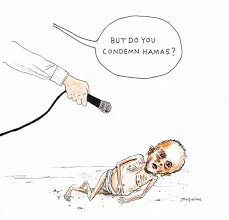
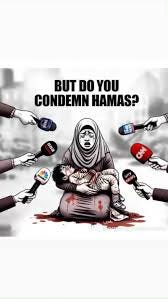

This is what I have to say about one-sidedness.
And about whether we should continue explaining it to those unwilling to examine why their first instinct, when confronted with this degree of injustice- this inhumanity, is to defend narrative symmetry rather than moral clarity.
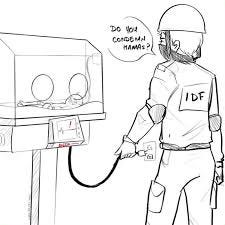
You can find various responses to the question by Finkelstein for example here . His position is widely shared:

Various people have clarified why they find the question a form of manipulation. And have their own way of responding. My personal favourite, is of Ali Abunimah’s. It is as simple as it is clear. In ei livestream episode on the 12th of November 2025, about the rise of Zohran Mamdani, he said,
“…but some of the positions you heard there and others during the campaign did dismay many of his supporters who worried that they these were early signs that he might back down in the face of pro-Israel pressure, you know, playing the condemnation game uh and and condemning October 7th in the terms that Israel supporters describe it rather than saying this was a resistance operation. Yes, any deliberate harm to civilians we would condemn, but nonetheless there’s a right to resist.”
you can watch the whole episode here.
For some deeper and philosophical interrogation into that question, you can also watch (I haven’t watched it in its entirety, so cannot vouch truthfully for all of it):
The cowardice of European leaders is simply stunning. An entire continent has voluntarily decided to fall prostrated as vassals to the leader of one sovereign state. A leader of a sovereign country, Venezuela, is kidnapped and shipped over to the US in violation of international law and not a beep from Europe. An armada of warship is encircling Iran for a baseless military attack largely ordered by Israel, coming fresh from a genocide in Gaza, yet all around there's only deafening silence. The people of Cuba are being slowly starved to death out of sheer cruelty. European leaders are behaving as if this is happening on a different planet. They are so scared to utter even a mild critique for fear of bringing punishing tariffs on their countries.
Trump has become what ancient Romans were afraid of Caesar in Shakespeare's Julius Caesar: "he bestrides the narrow world like a colossus and we petty men walk under his huge legs and peep about to find ourselves dishonourable graves. But as Cassius points out to his fellow Roman, Brutus, "the fault dear Brutus, is not in our stars, but in ourselves that we are underlings". It is inexplicable why Europe has so spectacularly surrendered itself to Trump.